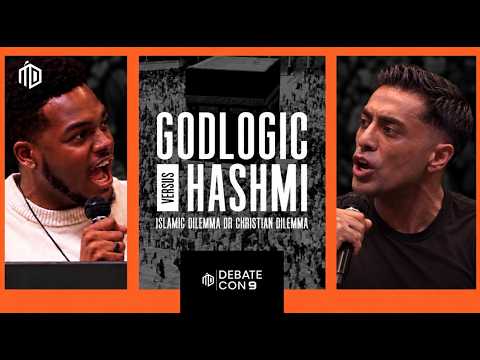
GodLogicApologetics said Quran 29:46 has Muslims say they believe in what was revealed to them and to Christians, and argued that the belief the Quran asks for in its own book must also apply to the Bible.
Loading debate…
Loading debate…
Islamic Dilemma or Christian Dilemma?
Summaries in our own words. Those marked as AI drafts were written by AI from the recording's captions and have not been checked by a person, so a summary or its speaker may be wrong. Every timestamp opens that moment on the host's channel so you can check it.
GodLogicApologetics said Quran 29:46 has Muslims say they believe in what was revealed to them and to Christians, and argued that the belief the Quran asks for in its own book must also apply to the Bible.
He read Quran 5:68, which tells the People of the Scripture to stand on the Torah and the Gospel, and argued that a Christian who observes those scriptures finds Jesus to be the divine Son who died and rose, which contradicts the Quran's denial of this.
He presented a conundrum: if Christians stand on their scriptures, Islam is false because it contradicts them, and if they do not, Islam is still false because the Quran tells them to stand on scriptures it calls true.
He argued that if the Bible was corrupted in transmission, the Quran is false for calling a false book true, and he cited textual variants and differing accounts, such as how Judas died.
He argued that Quran 10:94 treats earlier scripture as the standard of truth, so that if the Quran agrees with it the Quran is true, and if it does not, the Quran is false.
He cited Quran 5:47, which tells the People of the Gospel to judge by what God revealed in it, and argued that judging by the Gospel means judging the Quran to be false.
Citing the covenant with the prophets in Quran 3:81, he argued that a messenger is identified by confirming what earlier scriptures contain, so a Quran that does not match them shows Muhammad is not the messenger, and he said this is why he denies Muhammad as a prophet.
Hashmi argued that the Islamic dilemma offers only two options when a third exists, namely reinterpreting the Torah and Gospel, which he said is also the solution Christians use for the Christian dilemma.
He set out the Christian dilemma: the New Testament affirms the Old Testament, yet the Old Testament contradicts New Testament and Orthodox doctrines, and early figures such as Marcion noticed these discontinuities.
He listed discontinuities including the Trinity and the god-man, a covenant described as everlasting in the Hebrew Bible but obsolete in Hebrews, the perpetual Torah, differing views of atonement, sacrifice, circumcision, Sabbath, priesthood, and a messiah expected as a political figure.
He argued that the Proto-Orthodox Church read the Hebrew Bible allegorically, and that revelatory exegesis, an authoritative reinterpretation of earlier scripture through new revelation, is already found in the Hebrew Bible, as in Daniel's reading of Jeremiah.
He argued that the Gospel writers rewrote Mark, so the criticism of the Quran's use of earlier texts applies equally to them, and Muslims can therefore affirm the Torah and Gospel while holding that the Quran gives their divinely authorized interpretation.
He said the Quran's terms Torah and Gospel are polysemous: Torah mainly means divine law or the Mosaic proclamation including oral law, and Gospel mainly means Jesus' proclamation rather than the four written Gospels, which did not yet exist.
He said the Quran's word kitab primarily refers to celestial revelation and only secondarily to written texts, so the Quran's focus is on revelatory proclamation rather than physical books.
He argued that the Quran's word for confirms means fulfils, which includes modification: Jesus confirms the Torah in Quran 3:50 by making lawful some things that were forbidden, and the Quran confirms earlier revelation in the same sense.
Quoting Sinai, he said the Quran combines a claim to confirm earlier scripture with a claim to be its ultimate arbiter, and cited Quran 3:7 to argue that the clear verses (muhkam) should be used to understand the unclear verses of earlier scripture.
GodLogicApologetics argued that Polycarp, Irenaeus and Justin condemned Marcion as a heretic, and that someone who rejects the Old Testament and the Gospels of Matthew, Mark and John cannot be a Christian, so Marcion is not an example of Christian discontinuity.
Hashmi said that orthodoxy as a settled category emerged several centuries after Jesus, which is why scholars use the term proto-Orthodox, and that from an academic historical perspective he counts Marcion as a Christian.
GodLogicApologetics said orthodoxy means right belief, referring to the early tradition of what the first Christians held and passed on.
GodLogicApologetics argued that Christians face a similar dilemma, and that it is more acute for them because they accept the Hebrew Bible as scriptural canon, and he asked Hashmi to acknowledge this.
An audience member asked Hashmi whether he personally believes the scriptures were corrupted. Hashmi answered that he avoids the loaded term corrupted, that the texts had a history of modification from their original authors, and that historians do not hold the first five books to be by Moses.
An audience member asked why Muslims reject the Gospels because Jesus did not write them while accepting the Quran and Hadith although Muhammad wrote nothing, and what miracles show Allah is the God of the Bible. Hashmi said the argument applies to Hadith, that the Quran is an exception among historical scholars, that Allah is the Arabic word for God also used by Arab Christians, and that he does not believe in supernatural miracles.
An audience member asked how Hashmi interprets Mark 10:45, where Jesus gives his life as a ransom, in light of Quran 4:157. Hashmi said apologists misread Quran 10:94, and did not give a settled interpretation of Mark 10:45, saying he would not speak off the cuff.
GodLogicApologetics said he had answered Hashmi's questions directly, but he did not know Hashmi's position on what the Quran says about earlier scripture or on what the Injil is.
He cited Old Testament passages, including Deuteronomy 6:4 and 32, Isaiah 9:6, 2 Samuel 23:2-3, Genesis passages where Yahweh and the angel of the Lord appear, and Zechariah 12:10, to argue that the Hebrew Bible presents one God who is also Father, Son and Spirit, and said he did not need the New Testament for this.
He argued that Quran 2:85 asks whether believers accept part of scripture and reject the rest, and said that by relying on historical scholarship Hashmi accepts part of his scripture while rejecting other parts.
GodLogicApologetics concluded that the Christian dilemma is resolved in Jesus and that the Islamic dilemma was not addressed in the debate.
Suggested from the title and not yet checked by a person.
This debate was made for and published by the channel below. Watching it there supports the host.
Hashmi said this is a scriptural religions dilemma: scripture must invoke past scripture for authority while its meaning must be modified to remain applicable today, and this occurs in all scriptural traditions.
Hashmi said the Torah in the Quran includes the oral law and that the Injil is Jesus' proclamation, which is not identical to the written texts that preserve part of it.
Hashmi said there was no Arabic Bible in the Quran's setting, so the Quran refers to a proclamation preserved in writing and oral tradition, and that some churches accepted non-canonical texts.
GodLogicApologetics cited the account of the Muslim companions at the Ethiopian king's court, where they described Jesus as the word of God and the Messiah and the king said this matched the Injil, and he asked which gospel the king would have had in the seventh century.
Hashmi said Injil in the singular means the gospel message rather than a text, that the literary gospels were modelled on the Quranic message, and that the account is not a strong historical argument without contemporary sources.
GodLogicApologetics cited Quran 7:157, which describes the unlettered prophet as written in the Torah and Gospel the people have, and argued that the verse points to written scripture.
After Hashmi agreed that the New Testament confirms the Jewish scriptures and appeals to them, GodLogicApologetics argued that if the Tanakh were corrupted the New Testament would be false, and concluded that there is no Christian dilemma.
Hashmi said that argument was not serious, since early Christians claimed to identify satanic insertions in the Hebrew Bible and remove them through divine interpretation, so the same dilemma and solution apply to both faiths.
GodLogicApologetics asked whether Quran 2:79, about people writing with their hands, could refer to textual corruption of earlier scripture, since it uses the word kitab, which Hashmi uses for earlier scripture.
Hashmi answered that he does not read 2:79 as referring to corruption of the Torah, but to books people wrote with their own hands and presented as scripture.
Hashmi said many Christians accept textual alterations in the Gospels without losing their value as scripture, so a text need not be entirely uncorrupted to be useful.
GodLogicApologetics said Hashmi misapplied a hadith in which Muhammad tells the Muslims to neither believe nor disbelieve the Jews' oral reading but to affirm what was revealed to them, which he said supports the books' truth while questioning only their oral versions.
Hashmi said the three-in-one concept of God is not in the Hebrew Bible, and that this is one of the discontinuities between the Hebrew Bible and Christian doctrine.
GodLogicApologetics offered to show the Trinity from scripture and named Benjamin Sommer, Alan Segal and Michael Heiser as scholars who find it there, which Hashmi disputed, saying Sommer does not hold it and the two-powers idea does not reach the Trinity.
GodLogicApologetics cited Quran 61:6, in which Jesus announces a messenger named after him who will come after him, and argued that the Quran therefore says Muhammad is named in the Bible.
Hashmi said 61:6 does not say the Gospel or New Testament contains the name, but that it reports Abraham, Ishmael and Jesus prophesying a future messenger, without claiming the name appears in the Bible.
An audience member asked whether Jesus' claim to be the only way to eternal life brings back the Islamic dilemma. Hashmi answered that what matters is the Quran's understanding of Jesus' proclamation, that most New Testament scholars doubt that sentence goes back to Jesus, and that traditional Islam also holds a path to God through a prophet.
An audience member asked whether GodLogicApologetics would have raised the new covenant in the Old Testament prophets to explain the discrepancy between the Testaments. GodLogicApologetics answered yes, saying the new covenant is a way of explaining fulfilment rather than a patch, and Hashmi replied that the Quran also speaks of a new covenant with believers that could be used the same way.
Hashmi said that Quran 7:156, the verse before 7:157, uses the same word for decree, and that this word does not mean written in that verse.
Hashmi restated that in the Quran Torah and Gospel primarily mean the Mosaic proclamation with its oral law and Jesus' proclamation, with written scripture a secondary sense, and that the Quran gives divine interpretation of earlier writings, citing 6:91.
Hashmi concluded that the Hebrew Bible and New Testament are not univocal, that their discontinuities are resolved through divine or revelatory exegesis as all scriptural religions do, and that the so-called dilemma is resolvable.